

The Testaments (2026) arrives as a haunting, emotionally charged continuation of the dystopian nightmare that captivated audiences for years, yet it immediately proves that it is far more than a simple sequel. Set years after the events that shook Gilead in The Handmaid’s Tale, the series shifts its focus toward a younger generation born and raised under oppression, creating a fascinating perspective on a society where tyranny has become normal. Rather than revisiting familiar territory, the story explores what happens when children inherit the consequences of their parents’ battles. The result is a gripping coming-of-age drama wrapped inside a political thriller, where every smile hides fear, every rule conceals violence, and every act of obedience may be the first step toward rebellion. From the opening episode, the series establishes an atmosphere of dread and uncertainty that never loosens its grip, pulling viewers into a world that feels disturbingly plausible and emotionally devastating.
At the heart of the narrative are Agnes and Daisy, two young women whose lives unfold on opposite sides of Gilead’s ideological divide. Agnes has spent her entire life immersed in the regime’s teachings, believing that obedience is both virtue and survival. Daisy, meanwhile, enters the story carrying a different perspective, one shaped by experiences beyond the rigid boundaries of Gilead. Their journeys begin separately, yet the series cleverly weaves their destinies together through a complex web of secrets, revelations, and hidden histories. What makes their stories so compelling is that neither character fits neatly into the role of hero or victim. Instead, they are young women struggling to understand who they are in a world determined to define them. Their emotional growth becomes the driving force of the entire season, transforming the show from a political drama into a deeply personal exploration of identity, loyalty, and freedom.

One of the greatest strengths of The Testaments lies in its depiction of indoctrination. Unlike many dystopian dramas that focus primarily on overt brutality, this series examines how oppressive systems survive by shaping minds rather than merely controlling bodies. The elite schools, strict rituals, and carefully crafted lessons create an environment where obedience feels natural and resistance appears unimaginable. Watching the young women navigate these institutions is both fascinating and unsettling because the threat is not always visible. The series masterfully portrays how fear can be disguised as tradition and how control can masquerade as protection. Every classroom conversation and ceremonial gathering carries an undercurrent of tension, reminding viewers that the most dangerous prisons are often the ones people no longer recognize as prisons.
The return of Aunt Lydia adds another layer of complexity to the story. No longer portrayed simply as a cruel enforcer, she emerges as one of the show’s most intriguing and morally ambiguous figures. Her influence stretches across every aspect of Gilead’s social structure, and her interactions with the younger generation reveal a character torn between loyalty, guilt, and ambition. The series refuses to provide easy answers about her motivations, allowing audiences to question whether she is a guardian of the system or a potential architect of its downfall. Every scene involving Lydia crackles with tension because her true intentions remain hidden behind layers of calculated restraint. Her presence serves as a constant reminder that power often survives by adapting rather than resisting change.
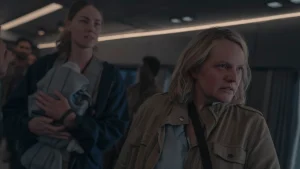
June’s emotional journey forms the beating heart of the season, and her character reaches new layers of complexity. The woman who once fought simply to survive now faces the burden of leadership, knowing that every decision could cost innocent lives. Her relentless determination is challenged by moments of doubt, grief, and rage as she confronts the haunting question of what justice truly means. Revenge has fueled her for years, but Season 6 asks whether vengeance can ever truly heal a wounded world. Her relationships with those around her—friends, former enemies, and fellow survivors—become increasingly complicated as the line between heroism and obsession begins to blur.
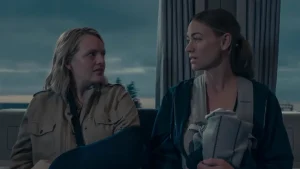
As the season progresses, The Testaments evolves into a sophisticated mystery. Hidden family connections, buried truths, and long-forgotten secrets gradually surface, transforming the narrative into an emotional puzzle where every revelation changes the audience’s understanding of previous events. The writers demonstrate remarkable patience, allowing mysteries to unfold naturally instead of relying on shock value alone. When major twists finally arrive, they feel earned because they are rooted in character development rather than mere surprise. The emotional impact of these revelations resonates deeply, forcing characters to confront painful realities about their identities, their families, and the society they inhabit.
Visually, the series is breathtaking in its ability to contrast beauty with horror. The architecture of Gilead appears elegant and orderly, yet every carefully composed frame conceals oppression beneath its polished surface. The cinematography frequently places characters within vast, imposing spaces that emphasize their lack of freedom, while intimate close-ups capture the fear and uncertainty hidden behind composed expressions. The use of color, lighting, and costume design reinforces the themes of control and conformity, creating a visual language that communicates as much as the dialogue itself. Every episode feels meticulously crafted, immersing viewers in a world that is simultaneously mesmerizing and terrifying.
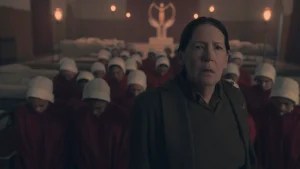
What truly elevates The Testaments beyond standard dystopian storytelling is its focus on female relationships. Friendship, sisterhood, mentorship, and betrayal become central pillars of the narrative. The bonds formed between the young women provide moments of warmth and hope amid overwhelming darkness. These relationships are not idealized; they are complicated, fragile, and often tested by the realities of survival. Yet they remain the emotional core of the series. Through these connections, the show explores the idea that resistance is not always born from grand revolutions but can emerge from simple acts of trust, compassion, and solidarity.
The pacing deserves particular praise because it balances character development with escalating suspense. Rather than rushing from one dramatic event to another, the series allows tension to build gradually. Small moments carry enormous significance because viewers understand the consequences that may follow. A glance across a room, a whispered conversation, or a seemingly harmless question can feel more suspenseful than an action sequence. This deliberate storytelling approach creates an atmosphere where danger is constantly present, even when nothing overtly threatening is occurring. The result is a viewing experience that feels intensely immersive and emotionally exhausting in the best possible way.
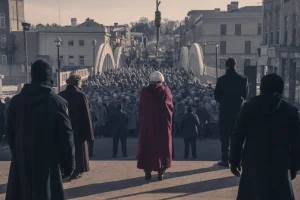
The performances across the cast are exceptional. The younger actors bring remarkable depth and vulnerability to their roles, ensuring that the audience remains invested in their journeys. Their portrayals capture the confusion, fear, hope, and determination of characters struggling to define themselves in an environment designed to suppress individuality. Meanwhile, the veteran performers provide a powerful counterbalance, embodying the authority and complexity of the older generation. Together, they create a dynamic ensemble that gives the series both emotional authenticity and dramatic weight. Every major character feels fully realized, making their triumphs and tragedies resonate long after each episode ends.
Beyond its compelling narrative, The Testaments succeeds because it asks important questions about power, belief, and social conditioning. The series examines how authoritarian systems sustain themselves across generations and how ordinary people become participants in structures that harm them. It challenges viewers to consider the difference between tradition and oppression, loyalty and complicity, faith and manipulation. These themes are explored with intelligence and nuance, avoiding simplistic conclusions while encouraging reflection. The show never forgets that its greatest strength lies not in its dystopian setting but in its exploration of human behavior within that setting.
As the season approaches its climax, the sense of inevitability becomes almost unbearable. Characters are forced to make impossible choices, alliances shift unexpectedly, and long-simmering tensions finally erupt. The emotional stakes reach extraordinary heights because the audience understands exactly what each character stands to lose. The finale delivers a powerful combination of heartbreak, revelation, and hope, providing satisfying answers while leaving enough uncertainty to fuel future stories. It is a conclusion that feels both earned and emotionally devastating, rewarding viewers for their investment while ensuring they remain eager for what comes next.
Ultimately, The Testaments stands as a remarkable achievement in modern television. It expands its predecessor’s universe while establishing its own distinct identity, blending psychological drama, political intrigue, and emotional storytelling into a compelling whole. The series is intelligent without being inaccessible, suspenseful without sacrificing character depth, and emotionally powerful without descending into melodrama. It offers a chilling portrait of a society built on control while celebrating the resilience of those who dare to challenge it. By the time the final credits roll, viewers are left not only entertained but deeply affected, making The Testaments one of the most gripping, thought-provoking, and unforgettable television experiences of 2026.