
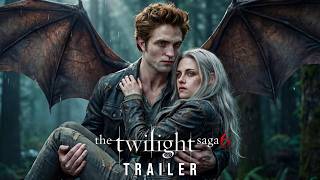
There’s an undeniable sense of myth reborn in The Twilight Saga 6: The New Chapter (2026)—a film that feels less like a sequel and more like a resurrection of a cultural phenomenon that once defined an entire generation. Set years after the quiet resolution of the Cullen family’s saga, the story opens in an eerie calm, where immortality has dulled neither memory nor consequence. Bella and Edward exist in a fragile equilibrium, raising Renesmee in a world that pretends peace is permanent, yet every frame whispers that something ancient is watching, waiting, and remembering.
What makes this imagined continuation so gripping is how it refuses to rely solely on nostalgia. Instead, it leans into evolution—of characters, of tone, and of the very mythology that once seemed complete. The film paints a darker, more mature canvas, where love is no longer the naive, all-consuming force it once was, but something tested by time, guilt, and legacy. The narrative dares to ask whether eternity is truly a gift or simply a longer sentence, stretching the emotional core of the saga into something far more haunting and introspective.

Renesmee emerges as the true axis of the story, no longer just the miraculous child who united enemies, but a being caught between identities she cannot fully control. Her accelerated growth becomes symbolic—not just physically, but emotionally—as she struggles to define herself beyond the shadows of her parents. The film explores her as both a bridge and a threat, a living paradox whose existence destabilizes the already fragile balance between vampires and werewolves, echoing the long-standing tensions of the saga in a far more volatile form.
The return of old forces—particularly the looming presence of ancient vampire factions—injects the film with a constant sense of dread. This isn’t the overt, explosive danger of previous installments, but something quieter and more suffocating. The threat feels intelligent, patient, and deeply personal, as if the past itself has decided to retaliate. Every interaction is layered with subtext, every alliance feels temporary, and every moment of calm is tinged with the inevitability of collapse.

Visually, the film leans into a colder, more desaturated palette, mirroring the emotional weight carried by its characters. The forests of Forks no longer feel like a sanctuary but a labyrinth of secrets, while the interplay of light and shadow reflects the moral ambiguity that defines this new chapter. The cinematography captures not just beauty, but decay—the slow erosion of certainty, of trust, and of the illusion that the Cullen family’s story had truly ended.
Edward and Bella’s relationship, once the beating heart of the saga, takes on a more complex and bittersweet tone. Their love is no longer about overcoming obstacles, but about enduring them—quietly, relentlessly. There’s a sense that they are no longer fighting for each other, but for what remains of their family, their identity, and their place in a world that continues to evolve without them. Their bond feels heavier, almost burdened by the weight of everything they have survived.

Jacob Black’s presence adds another layer of emotional tension, particularly in his connection to Renesmee. What once felt like a controversial but stabilizing force now becomes a source of internal conflict. His loyalty is unwavering, yet increasingly strained by the realization that the world he once understood is slipping beyond his control. His role evolves from protector to reluctant witness, caught between duty and the growing fear that he may not be enough.
One of the film’s greatest strengths lies in how it expands the mythology without losing its emotional core. New supernatural elements are introduced—not as spectacle, but as extensions of the world’s existing logic. These additions deepen the sense of scale, suggesting that the Cullen family’s story was always just a fragment of something far larger, something older, and far more dangerous than they ever imagined.

The pacing of the film is deliberate, almost meditative at times, allowing tension to build gradually rather than relying on constant action. This slower rhythm enhances the psychological weight of the story, drawing the audience deeper into the characters’ internal struggles. When moments of conflict do erupt, they feel earned—raw, chaotic, and emotionally devastating rather than purely cinematic.
At its core, The New Chapter is a story about legacy—about what we leave behind, and what refuses to stay buried. It challenges the idea that happy endings are permanent, suggesting instead that they are merely pauses between battles. The film doesn’t seek to undo the conclusion of the original saga, but to reinterpret it, revealing that even in immortality, nothing is ever truly finished.

There is also a quiet melancholy that runs through the film, a recognition that time changes everything—even those who are meant to be timeless. The characters are no longer the same people audiences once knew; they are shaped by years of survival, loss, and adaptation. This transformation gives the film a sense of realism that contrasts sharply with its supernatural elements, grounding its more fantastical aspects in genuine emotional truth.
By the time the film reaches its climax, it becomes clear that this is not just a continuation, but a redefinition. The stakes are no longer confined to a single family or even a single species—they are existential, questioning the very structure of the world the saga has built. The ending doesn’t offer closure in the traditional sense, but rather a haunting sense of continuation, leaving the door open for stories yet untold.
Ultimately, The Twilight Saga 6: The New Chapter stands as both a tribute and a transformation—honoring the legacy of what came before while daring to evolve beyond it. It captures the essence of what made the original saga resonate—love, conflict, identity—while pushing those themes into darker, more mature territory. Whether real or imagined, it feels like the kind of sequel that doesn’t just revisit a story, but dares to ask what happens after the ending we thought we understood.