
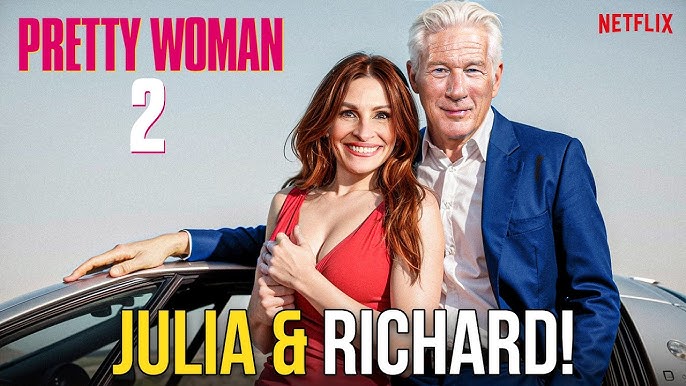
🎬 PRETTY WOMAN 2: A SECOND CHANCE (2026)
Few romantic films have left a cultural imprint quite like Pretty Woman, and with Pretty Woman 2: A Second Chance (2026), the story dares to revisit that legacy—not by simply repeating it, but by reimagining what love looks like years later. This sequel is not just about rekindling nostalgia; it’s about exploring how time reshapes people, relationships, and the meaning of happiness itself. From the very beginning, the film makes it clear: this is a story about growth, not just romance.
Set years after Vivian and Edward’s iconic love story first unfolded, the film reunites us with two people who once defied expectations—but now must face the quiet realities of life beyond the fairy tale. Success has changed them, comfort has softened some edges, and yet, beneath it all, there lingers a question neither has fully answered: what happens after “happily ever after”?

Julia Roberts returns as Vivian with a performance that feels both familiar and refreshingly evolved. She brings warmth, confidence, and a quiet complexity to the role, portraying a woman who has grown into her own identity but still carries echoes of her past. This version of Vivian is no longer defined by where she came from, but by the choices she continues to make.
Richard Gere’s Edward, on the other hand, is more introspective than ever. The once-commanding businessman now finds himself confronting the emotional cost of a life built on control and ambition. Gere plays him with subtle restraint, allowing small gestures and expressions to reveal a man who is beginning to understand that success without connection can feel strangely hollow.

What makes this sequel stand out is its willingness to embrace imperfection. Vivian and Edward are no longer the idealized figures of a classic romance; they are flawed, sometimes distant, occasionally uncertain. Their relationship feels more grounded, shaped by time, misunderstandings, and the natural drift that can occur even between two people deeply in love.
The film introduces a new generation of characters who act as both contrast and reflection. Younger, more impulsive, and navigating a different social landscape, they highlight how much the world has changed—and how some emotional truths remain constant. These new faces bring fresh energy to the story while allowing the central relationship to be seen through a different lens.

Visually, A Second Chance trades the glossy fantasy of the original for something more subdued and reflective. The settings still carry elegance—luxury hotels, quiet city streets, intimate interiors—but there is a softness to the cinematography, as if the film itself is looking back with a sense of nostalgia tinged with realism.
Romance in this sequel unfolds differently. It is less about grand gestures and more about rediscovery. Small moments—shared silences, hesitant conversations, a simple touch—carry more weight than sweeping declarations. The film understands that love, especially after time has passed, is often about choosing each other again, rather than falling for the first time.

The pacing allows the story to breathe, giving space for reflection and emotional nuance. Rather than rushing from one dramatic moment to the next, it lingers on the in-between—the pauses, the doubts, the quiet realizations. This slower rhythm may surprise those expecting a conventional romantic sequel, but it ultimately serves the film’s deeper intentions.
Themes of identity, second chances, and emotional honesty run throughout the narrative. The film asks whether people can truly change, and if so, whether love can adapt alongside them. It explores the idea that sometimes the hardest part of a relationship isn’t beginning it—but sustaining it through the inevitable transformations life brings.

The chemistry between Roberts and Gere remains undeniable, though it has matured into something more restrained and layered. There is history in every glance, a sense of shared memory that adds depth to even the simplest interactions. Their connection feels less like a spark and more like an enduring flame—quieter, but still powerful.
By the time the film reaches its final act, it doesn’t seek to recreate the magic of the original—it redefines it. The resolution is not built on fantasy, but on acceptance, understanding, and the courage to face uncertainty together. It’s a conclusion that feels earned, even if it resists the simplicity of a perfect ending.
Pretty Woman 2: A Second Chance (2026) ultimately stands as a thoughtful continuation of a beloved story. It respects its origins while daring to move beyond them, offering a more mature and introspective take on love. This is not just a return to a classic—it’s a reminder that every love story, no matter how iconic, deserves the chance to grow.