

VERITY (2026) is not just a psychological thriller—it feels like stepping into a beautifully constructed nightmare where truth and fiction slowly devour each other. Directed with a haunting, almost hypnotic tone, the film pulls you into the fragile mind of a struggling writer who thinks she’s been given a second chance at life—only to discover she may have walked straight into a trap. From the very first moments, the atmosphere is thick with unease, like something is watching, waiting, and quietly unraveling reality itself.

At the center of the story is Lowen Ashleigh, portrayed with quiet intensity by Dakota Johnson. Financially broken and emotionally adrift, Lowen accepts an offer that seems too good to be true: finishing a bestselling book series for the injured author Verity Crawford. What begins as a professional opportunity quickly spirals into something far more disturbing when Lowen moves into the Crawford mansion—a place that feels less like a home and more like a psychological maze filled with shadows, silence, and secrets.
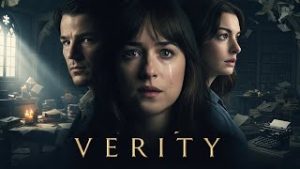
Inside this house, the film begins to truly breathe—and suffocate. Anne Hathaway delivers a chilling, almost ghost-like presence as Verity Crawford, a woman confined physically yet omnipresent psychologically. Even when she barely moves, her existence dominates every frame, creating a constant tension that never releases. The film plays dangerously with perception: is Verity a victim, a monster, or something even more complex? Every glance, every still moment feels loaded with meaning, forcing the audience to question everything they see.
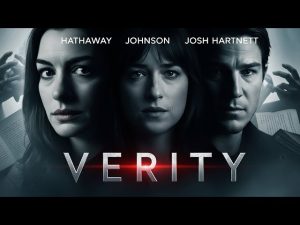
Then there is Jeremy Crawford, played by Adam Driver, whose performance adds another layer of emotional ambiguity. He is warm, grieving, and seemingly sincere—but beneath that sincerity lies something unreadable. His connection with Lowen grows in a way that feels both intimate and unsettling, blurring the lines between comfort and manipulation. The chemistry between the characters becomes a slow-burning tension that keeps tightening like a knot, making every interaction feel like it could snap at any second.

What makes Verity so gripping is how it weaponizes storytelling itself. As Lowen uncovers an unpublished manuscript hidden within the house, the film transforms into a story within a story—a disturbing confession that may or may not be true. The deeper she reads, the more reality begins to fracture. The audience is dragged into the same psychological spiral, unsure of what is real, what is fabricated, and whether the truth even matters anymore. It becomes less about solving a mystery and more about surviving it.

By the time the film reaches its climax, it doesn’t simply reveal answers—it leaves scars. The ending lingers like a whisper you can’t shake off, forcing you to replay every moment, every clue, every lie. Verity (2026) isn’t just a thriller; it’s an experience that crawls under your skin and stays there. It dares you to trust what you see—and then punishes you for it, leaving behind a chilling question: what if the most dangerous stories are the ones we choose to believe?